
SAT Inference Questions: Tips, Practice, and 5 Review Steps
SAT inference questions tips and practice: check passage support, label traps, rewrite clues, fix gaps, and choose a follow-up review step.
Try a question now. No account needed.

SAT Inference Questions: Tips, Practice, and 5 Review Steps
After grading SAT inference questions, I check my reasoning - not just my score. I review missed answers and correct guesses, then re-solve each question before reading the explanation.
I use five steps:
- Check passage support: Find the text that supports the answer.
- Label the trap: Name why the wrong choice seemed right.
- Rewrite the clue: State the supported conclusion in plain English.
- Find skill gaps: Look for repeated reasoning mistakes or rushed decisions.
- Track results by type: Compare accuracy, confidence, and recurring errors across practice sets.
A correct guess still counts as correct: 8 correct out of 10 = 80% accuracy, but I flag uncertain answers for review. I finish with <u>one specific habit to practice</u> and a new question set to check whether it helps.
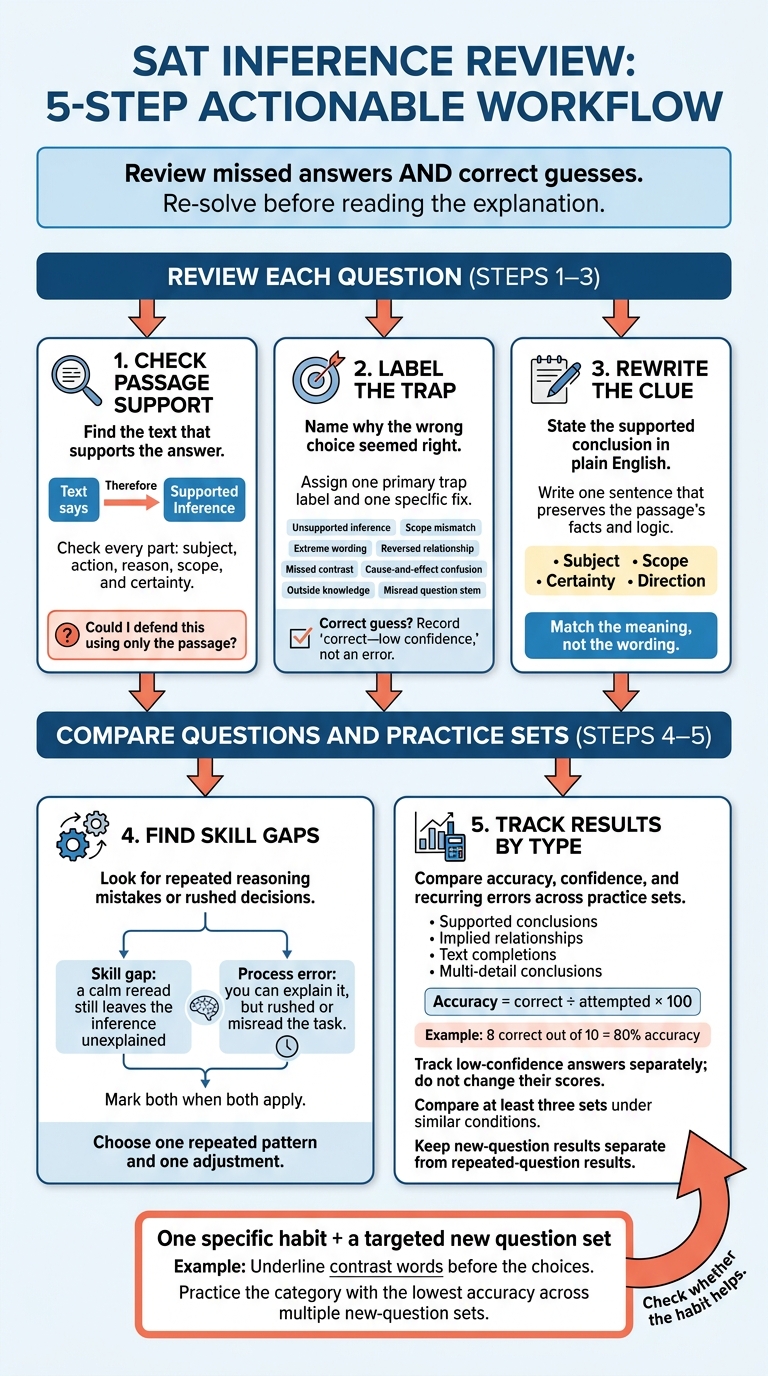
SAT Inference Review: 5 Steps After Grading
Step 1: Check the Passage Support
Solve the question again before reading the explanation. After grading, hide the explanation, reread the question, and return to the passage. Predict an answer before checking the choices. This helps you see whether you misread the question, chose weak evidence, or made an unsupported leap rather than simply guessed wrong.
Record the shortest piece of support you can defend: a phrase, sentence, contrast, or relationship. Explain why it works using two labels: “Text says” for explicit information and “Therefore” for the conclusion that information supports. The wording doesn’t need to match the answer exactly, but the meaning must hold up. Once you’ve pinned down the support, identify the trap that led you away from it.
Check every part of the answer - not just its main idea. Does the passage support its subject, action, reason, scope, and level of certainty? Strong claims such as always, proves, and the only reason need stronger evidence than may or suggests. Events happening in sequence do not, by themselves, prove cause and effect.
Ask:
Could I defend this using only the passage?
Reject reasoning that depends on outside knowledge or an extra assumption. Even a less certain claim needs passage support and must answer the question directly.
Now read the explanation and compare its reasoning with yours. If you missed a contrast or linked the wrong details, revise your evidence note to include the missing connection. That record will help you spot patterns later. If you still can’t identify the support - even when you chose the right answer - mark your reasoning as unverified. Then label the trap type in Step 2.
Step 2: Label the Answer Trap
After you check the passage support, name the trap that led you away from it. Give each wrong answer or tempting distractor one primary trap label. Then write one sentence explaining the mismatch and what to do next.
Match Each Trap to a Fix
Use these labels to turn each miss into a specific fix.
| Trap label | Diagnostic question | Correction |
|---|---|---|
| Unsupported inference | What passage detail supports the added claim? | Remove the unstated assumption. |
| Scope mismatch | Does the choice match the relevant group, time period, and conditions? | Match the choice’s scope to the evidence and question. |
| Extreme wording | Does the text support this level of certainty? | Choose wording no stronger than the text supports. |
| Reversed relationship | Did the choice reverse the relationship’s direction? | Draw the relationship’s direction, then check the choice against it. |
| Missed contrast | Did I overlook a transition or qualification? | Mark the contrast and summarize both sides. |
| Cause-and-effect confusion | Does the text show causation - or only association or sequence? | Separate causation from association or sequence. |
| Outside knowledge | Does my reasoning depend on information absent from the passage? | Remove the outside assumption and check the choice again. |
| Misread question stem | Did I answer the task the question actually asks? | Restate the question’s task in plain language. |
Use scope mismatch for reach, extreme wording for certainty, and outside knowledge only when the passage never supplies the needed fact.
If you guessed correctly, record correct - low confidence, not an error. If you guessed without a runner-up, note the missing reasoning step.
Step 3: Rewrite the Main Clue
Once you spot the trap, rewrite the clue in one plain-English sentence. Keep the passage’s key facts, subject, and logic.[1][4]
Name only the relationship the passage supports: cause and effect, contrast, comparison, condition, sequence, or correlation. This gives you a clear claim to test.[3][5]
Before returning to the choices, write the shortest claim the clues support. Use cautious wording if the passage leaves room for doubt.[1][3][6]
Compare your rewrite with the correct answer. Check subject, scope, certainty, and direction - match the meaning, not the wording.[1][5]
If they differ, find the first point where your reasoning went beyond the passage. Revise your sentence and prediction, then save the corrected reasoning - not just the answer letter - to track patterns later.[1][2]
Step 4: Find Repeated Skill Gaps
After you’ve checked support, named the trap, and rewritten the clue, compare several questions. Review missed questions alongside those you felt unsure about. Re-solve each one before reading the explanation. Use the explanation to check your thinking, not do the work for you.
Look for repeated trouble with finding evidence, drawing inferences, matching scope, or rejecting distractors. Pinpoint the first wrong step: Did you miss a clue, misunderstand how it connects to another detail, or accept an answer without support?
Separate skill gaps from process errors. If a calm reread still leaves you unable to explain the inference, mark a skill gap. If you can explain it but rushed or misread the task, mark a process error. Mark both when both apply.
For each question, record its number, the key clue, your answer, the correct answer, the error category, and any process issue. Write a reason you can act on:
“Missed the contrast” is more useful than “bad at reading.”
Tally your labels, then choose one repeated pattern and one adjustment for the next set. Your fix might be to require evidence, mark transitions, or circle limiters. Apply the same fix to every question so you can check whether the error repeats. Save these pattern notes for Step 5, where you’ll sort results by question type.
Step 5: Track Results by Inference Question Type
Bring your Step 1–4 notes into one tracking log.
For each question, record the date, question identifier, main category, result, confidence, trap label (if applicable), evidence clue, and next action. Rate your confidence as high, medium, or low before checking the answer key. Flag correct answers with low confidence for review, too.
Use four categories in your log: supported conclusions, implied relationships, text completions, and multi-detail conclusions. Assign one primary category to each question. If the prompt asks which choice most logically completes the text, choose text completions. Otherwise, classify it by the main reasoning task.[2]
Calculate Accuracy and Choose Your Next Set
Use your logged results to decide what to practice next.
Record attempted, correct, and incorrect counts for each category. Calculate accuracy = correct ÷ attempted × 100. Compare at least three sets completed under similar conditions before calling a category weak. Track low-confidence answers separately - including correct ones - without changing their scores.
Keep new-question results separate from repeated-question results so remembered answers don’t inflate your progress. Focus on the category with the lowest accuracy across multiple new-question sets. Use confidence ratings and recurring trap labels to decide what needs attention first.
Start with untimed practice: explain the evidence for your answer and why each distractor is wrong. Then check your improvement with a short timed set of new questions.
Review Graded Answers in SAT Practice Bot
Use SAT Practice Bot’s explanations after grading, answer review, and progress tracking to help review your work.[7] Keep your categories, confidence ratings, trap labels, and next actions in a separate spreadsheet or notebook. Refer to that log to review missed clues, recurring traps, and what to do next.
Conclusion: Repeat the 5-Step Review
Repeat the five-step review, noting the first point where your reasoning stopped matching the text.
End each review with one specific adjustment and a targeted next set.
Choose one checkable habit, such as underlining contrast words before the choices.
Next, practice the inference type with the highest error rate in your log.
Track progress through clearer explanations supported by passage evidence, fewer repeated traps, and accuracy trends across comparable practice sets.
FAQs
How long should I spend reviewing each inference question?
Reviewing an inference question should usually take longer than answering it on test day. Take the time you need to follow the reasoning, spot where your logic went off track, name the trap type, and write a specific takeaway you can use in future practice.
Go beyond finding the right answer. Understanding the patterns behind your mistakes matters more than finishing your review fast.
What if two answer choices seem equally supported?
Reread the passage and compare how well it supports each choice. Focus on the author’s main purpose, not minor details. Look for keywords and clues in how the passage is organized. Eliminate any choice with a flawed, unsupported, or contradictory part - the whole answer must be supported.
If you use SAT Practice Bot, review its explanations after grading to understand why one choice is correct and how to tell similar options apart in future practice.
What should I change if my inference accuracy plateaus?
Don’t just check which answers you got right. Track the mistakes you repeat in an error log, noting the question types and traps that trip you up. Use SAT Practice Bot’s answer reviews and explanations to spot missing evidence, misread passage structure, or choices that sound familiar but lack support.
Set a focused practice goal based on the pattern you find. Keep reviewing explanations until you can explain the reasoning yourself without guessing.