
SAT Vocabulary Builder: A 7-Day Routine for Digital SAT Words
Use this SAT vocabulary builder: a 7-day routine to learn digital SAT words from context, review them on a schedule, and practice in short daily sessions.
Try a question now. No account needed.
SAT Vocabulary Builder: A 7-Day Routine for Digital SAT Words
Strong vocabulary can make a real difference on the SAT, especially in Reading and Writing, where tone, nuance, and word choice matter. On the digital SAT, vocabulary is tested through Words in Context questions in the Craft and Structure domain: a short passage with a blank, and you choose the most logical and precise word. That means you need to know how words are used, not just their dictionary definitions.
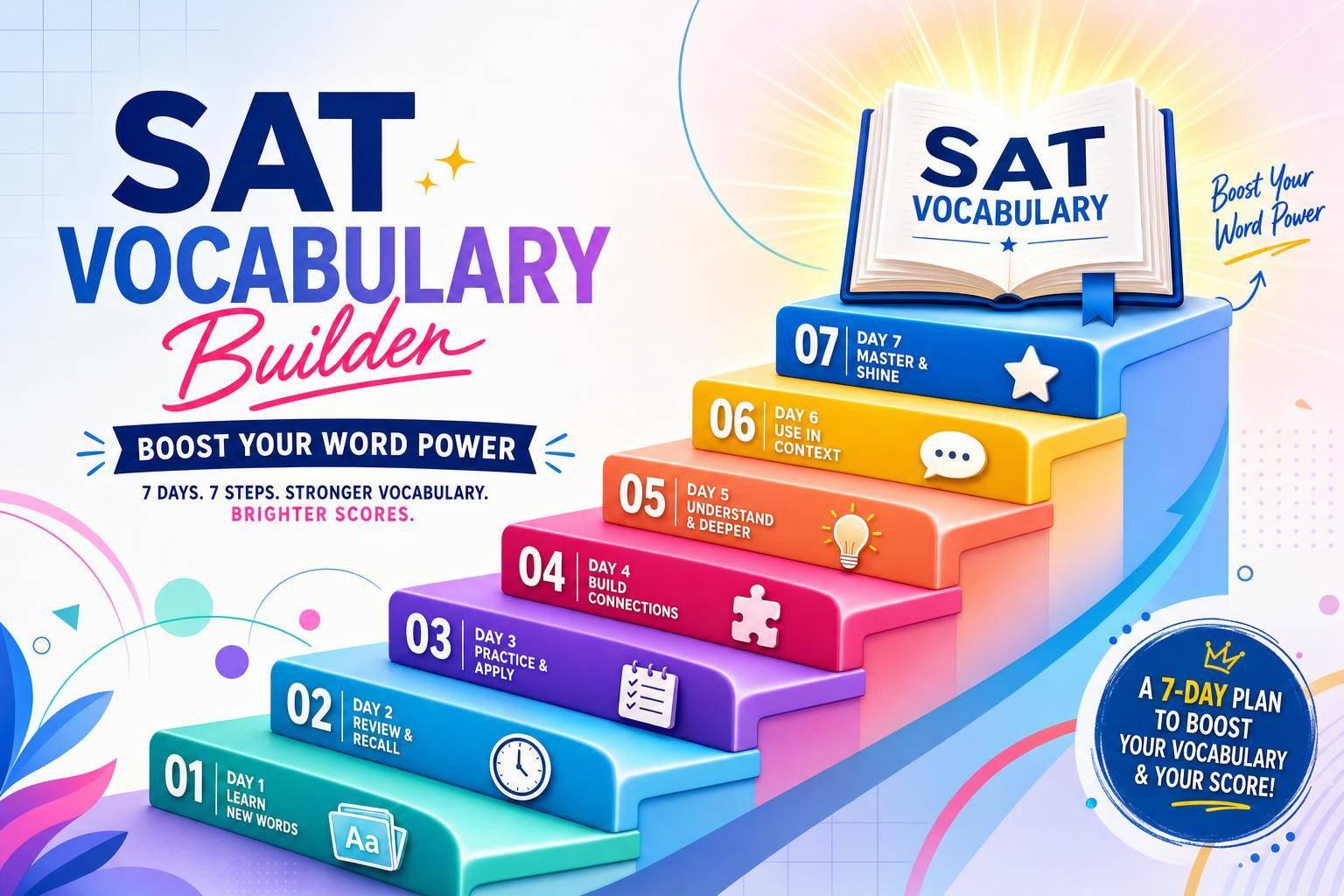
A 7-day routine you can run yourself
Pick 10, 20, or 30 minutes a day. The steps stay the same; only the number of words changes (about 3, 5, or 8 new words a day).
| Day | What to do |
|---|---|
| 1 | Read one article from a science, history, or opinion source. Write down unfamiliar words with the full sentence each one appeared in. |
| 2 | For each word, guess the meaning from context first, then check a dictionary. Note any second meanings. |
| 3 | Write your own sentence for each word. Do Words in Context practice questions. |
| 4 | New reading, new words. Quickly review Day 1–2 words. |
| 5 | Practice questions; for each miss, write down the clue you overlooked. |
| 6 | Mixed review of all words from the week. |
| 7 | Short quiz on yourself: cover the definitions and explain each word using its original sentence. |
Tips that make words stick
- Learn second meanings. Many SAT words are common words used in a less common way ("check" as restrain, "qualify" as limit).
- Keep the sentence. A word with its original sentence is easier to remember than a bare definition.
- Review on a schedule. Come back to a word after 1 day, 3 days, and a week.
Practice with real-style questions
SAT Practice Bot doesn't build personalized vocabulary lists. Its curated Reading and Writing practice includes Words in Context questions, with explanations after grading and spaced review of questions you miss, free during the beta. Try the free samples on our Craft and Structure practice page.
For the clue patterns behind these questions, see SAT Sentence Completion Patterns Explained and the Ultimate Guide to SAT Vocabulary in Context.
FAQs
Which words should I study?
Words you actually meet in academic reading, plus common words with less common meanings. Huge memorized lists matter less on the digital SAT, because each question gives you context.
Is 10 minutes a day enough?
It's a solid start if you're consistent. Short daily sessions with review beat a long session once a week.
Should I focus on context clues or word roots?
Mostly context clues, since every question gives you a passage. Roots help as a backup when a word is unfamiliar.