
Substitution and Elimination: Practice Questions
Choose the fastest SAT method for systems: substitution, elimination, expression shortcuts, special cases, and quick solution checks.
Try a question now. No account needed.

Substitution and Elimination: Practice Questions
Most digital SAT systems questions come down to one choice: use substitution if a variable is already alone, and use elimination if the coefficients line up. If your work ends in a false statement, there is no solution. If it ends in something like 0 = 0, there are infinitely many solutions.
I’d use this article for four things: picking the faster method, solving linear and nonlinear systems, handling word problems, and finding target expressions like 3x + 2y without doing extra algebra. On the digital SAT, that matters because many algebra questions reward the shortest correct path, not the longest one.
- Substitution: best when one variable is isolated or close to isolated
- Elimination: best when variable coefficients match or are opposites
- Expression questions: combine equations to get the asked value fast
- Special cases: check for one solution, no solution, or infinitely many solutions
- Word problems: define variables first, then build two equations
- Check every answer: plug back into both original equations
Every correct answer to a system has to work in both original equations. If your pair fails even one equation, the algebra is off.
| Question type | Best first move | What to watch for |
|---|---|---|
| One variable already alone | Substitution | Sign and distribution mistakes |
| Matching coefficients | Elimination | Forgetting to multiply every term |
Asked for x + y or 3x + 2y |
Combine equations first | Solving for x and y when you do not need to |
| Parallel or same line cases | Eliminate and read the result | False statement vs. identity |
| Word problems | Define variables clearly | Wrong setup or wrong units |
| Nonlinear systems | Usually substitution | Extra answers that do not fit both equations |
I’d treat this article as a short SAT playbook: scan the system, pick the method that takes fewer steps, and check the result before moving on.
Substitution vs. Elimination: A Quick Overview
Use substitution when one variable is already isolated, or when you can isolate one without much work. Use elimination when you can add or subtract the equations and cancel a variable fast.
The next two subsections show when each method is the better choice.
Comparison Table: Substitution vs. Elimination
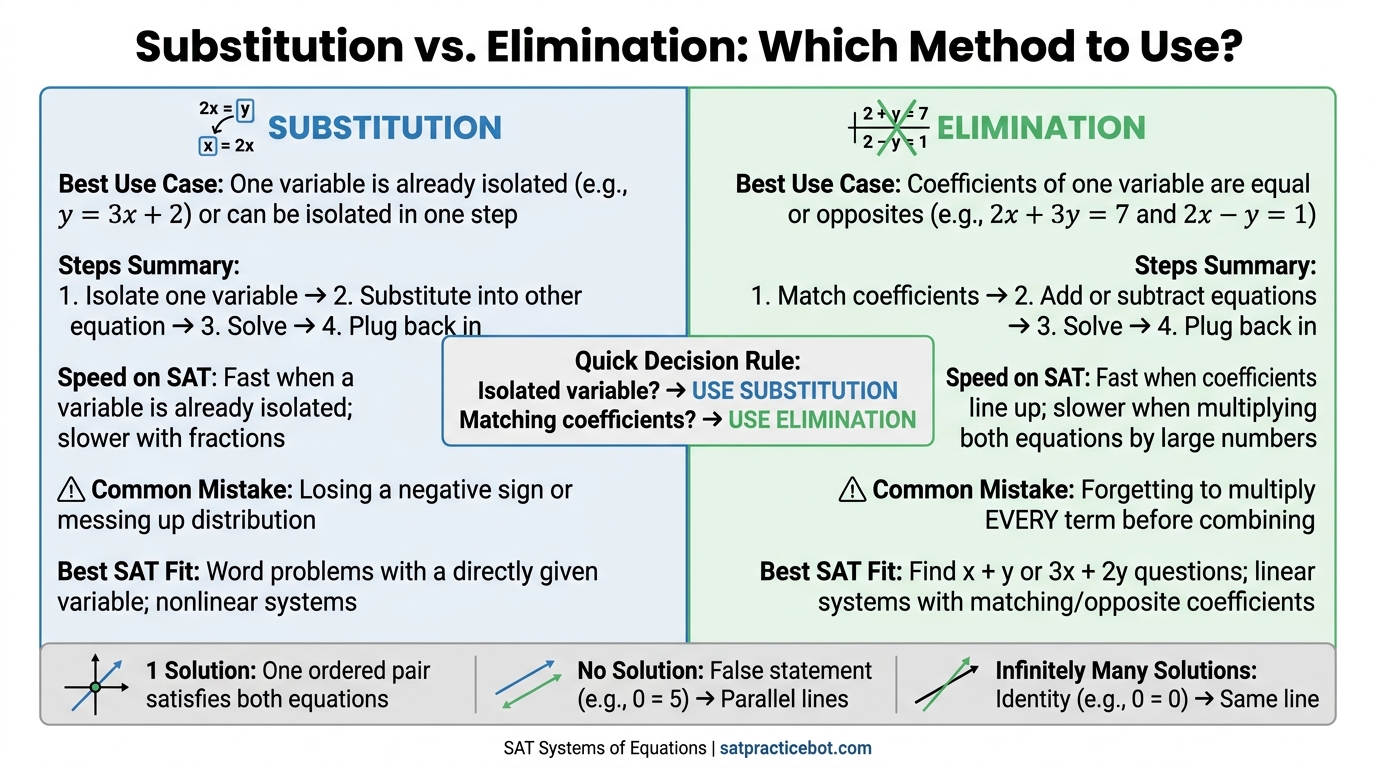
Substitution vs. Elimination: SAT Systems of Equations Cheat Sheet
Use this table to pick the fastest method on each digital SAT systems question.
Substitution and elimination comparison table
| Factor | Substitution | Elimination |
|---|---|---|
| Best Use Case | One variable is already isolated (for example, y = 3x + 2) or can be isolated in one step |
Coefficients of one variable are equal or opposites (for example, 2x + 3y = 7 and 2x − y = 1) |
| Main Steps | Isolate one variable, substitute, solve, then plug back in. | Match coefficients, add or subtract the equations, solve, then plug back in. |
| Speed on SAT | Fast when a variable is already isolated; slower when you have to rearrange fractions | Fast when coefficients line up cleanly; slower when you must multiply both equations by large numbers |
| Common Mistakes | Losing a negative sign or messing up distribution. | Forgetting to multiply every term before combining equations. |
| Best SAT Fit | Word problems where one equation gives a variable directly; nonlinear systems | “Find the value of x + y” questions; linear systems with matching or opposite coefficients |
Use this table before the drills below when the best method is not obvious.
1. Drill Systems with Curated Algebra Practice
Systems of linear equations are part of the digital SAT's Algebra domain. SAT Practice Bot offers curated Algebra practice with explanations after grading and step-by-step help, free during the beta. Start with the free samples on our Algebra practice page, which include an "infinitely many solutions" question. Repeated practice helps you notice common system types faster and see when substitution or elimination is the better move.
Spot the equation form
First, look at how each system is written before you start solving. Is it in standard form, slope-intercept form, or does one equation already have a variable isolated? That quick scan matters. It often tells you right away which method will save time.
Choose the faster method
After you identify the form, pick one method and stick with it. Then use the explanation to check whether your choice was efficient. Over time, this gets less mechanical and more instinctive.
SAT skill focus
On the digital SAT, speed comes from pattern recognition as much as algebra. Repeated practice helps method choice become more automatic, which can cut down the time you spend deciding how to start.
Solution-check habit
After each problem, check the ordered pair right away. Plug it into both equations before moving on. It takes a few seconds, and it can catch small mistakes before they cost you more points.
2. Linear Systems Best Solved by Substitution
Use substitution when one equation already has a variable by itself. That gives you a clean start. Put that expression into the other equation, solve for the remaining variable, and then plug that value back in to get the second variable.
Best solving method
Take the isolated variable and substitute it into the other equation. Solve for the variable that’s left. Then substitute back to find the missing value.
This method is often the fastest choice when the setup is already done for you. Still, small mistakes can sneak in. The big ones are sign mistakes, distribution mistakes, and plugging into the wrong equation.
Solution-check habit
Check your ordered pair in both original equations. If it doesn’t work in even one of them, go back and look at your substitution step and your signs.
3. Linear Systems Best Solved by Elimination
Elimination usually works best when the system is in standard form, Ax + By = C. Why? The matching variable terms line up, so you can add or subtract the equations without extra cleanup. Here’s a clean digital SAT-style example:
3x + 2y = 16
3x - y = 7
Subtract the second equation from the first:
(3x + 2y) - (3x - y) = 16 - 7
That gives:
3y = 9
So:
y = 3
Now plug y = 3 into 3x - y = 7:
3x - 3 = 7
3x = 10
x = 10/3
So the solution is:
(10/3, 3)
Then check the pair in both original equations.
If the coefficients don’t match, multiply one or both equations by a constant first. Use the smallest multiplier that avoids fractions.
SAT skill focus
Graph both equations in the built-in Desmos calculator (available on the whole Math section) and check that the intersection point matches your answer.
Solution-check habit
Substitute your ordered pair into both original equations. A sign error during subtraction is easy to miss.
4. Mixed Systems: Choose Your Method
Use the comparison table above, then look at the setup and pick the faster path.
Spot the setup
Start by reading the equations before you do any work. If one variable is already by itself, or almost by itself, substitution is usually the better move. If the coefficients already match, or can match with a small change, elimination is often faster.
This saves time on the digital SAT. Instead of forcing one method every time, match the method to the setup.
isolated variable = substitution; matching or easily matched coefficients = elimination.
Solution-check habit
After you solve, test your ordered pair in both original equations. A pair can look right in one equation and still fail in the other if you made a sign mistake or arithmetic slip.
That quick check can save points. If either equation doesn’t work, go back and fix the algebra before moving on.
5. Word Problems with Systems of Equations
Word problems use the same math. The hard part is turning the situation into equations.
Start by defining your variables. Then write two equations from the facts in the problem. After that, solve the system with substitution or elimination.
A simple way to stay organized:
- Choose what each variable means.
- Write one equation for each fact.
- Solve the system.
- Check that your answer makes sense in the context.
For the digital SAT, this matters because many algebra questions hide the setup inside a short scenario. If you rush, it’s easy to mix up what each variable stands for. A clean setup saves time and cuts mistakes.
Example: If adult tickets cost $12 and student tickets cost $8, and 10 tickets cost $104 total, let (a) be the number of adult tickets and (s) be the number of student tickets. Then:
(a + s = 10)
(12a + 8s = 104)
From there, use substitution: s = 10 − a, so 12a + 8(10 − a) = 104, which gives 4a = 24. So a = 6 and s = 4. Check: 6 + 4 = 10 and 12(6) + 8(4) = 72 + 32 = 104.
6. Expression Questions: Finding the Value of 3x + 2y
These questions still use system-solving moves, but the point is not to find x and y one at a time. The point is to get the target expression. Use substitution or elimination only if they help you reach what the question asks for.
Equation Form
A common setup looks like this:
2x + y = 10
x + y = 7
The question asks: What is the value of 3x + 2y?
Best Solving Method
The fastest move is often to combine the equations so the target expression shows up at once. Here, add the two equations:
(2x + y) + (x + y) = 10 + 7
That gives:
3x + 2y = 17
So the answer is 17.
If needed, multiply one equation by a constant and then combine it with the other. The goal is simple: make the target expression appear with as little work as possible. If it appears right away, stop there. If not, use the smallest multiplier that gets you there.
SAT Skill Focus
The goal is the expression, not x and y by themselves. On the digital SAT, this kind of question checks whether you can spot the target expression fast and avoid extra algebra.
Solution-Check Habit
After you get the result, it can help to check your work by solving for x and y and plugging them back into both equations. That extra check can catch a sign mistake or bad arithmetic.
FAQ
Do I always need to solve for x and y first?
No. If you can build the target expression by combining the equations, that's usually the better move.
When should I multiply an equation first?
Do it when the target expression does not appear from a direct add or subtract step.
Why does this matter on the SAT?
Because speed matters. The test often rewards the shortest correct path, not the longest one.
7. Systems with No Solution or Infinitely Many Solutions
Not every system has one solution. Some systems have no solution because the lines are parallel. Others have infinitely many solutions because both equations describe the same line. You can use substitution or elimination to tell which case you have. If your work ends with a false statement, the system has no solution. If it ends with an identity like (0=0), the equations represent the same line, so there are infinitely many solutions.
That simple check matters on the digital SAT. A system does not always lead to one ordered pair, and the test may ask you to spot when a system has no intersection or when both equations overlap.
Example: 2x + 3y = 6 and 4x + 6y = 10. Multiply the first equation by 2 to get 4x + 6y = 12. Subtract the second equation and you get 0 = 2, a false statement, so the system has no solution (the lines are parallel). If the second equation were 4x + 6y = 12 instead, you'd get 0 = 0, and there would be infinitely many solutions. Try a real example on our Algebra practice page.
Use that same habit of checking your result on nonlinear systems too. In many of those problems, substitution is often the fastest path because one equation can be plugged into the other right away. If your algebra starts giving you something impossible or something that is always true, pause and ask what that says about the system before you keep going.
8. Nonlinear Systems Solved by Substitution
Substitution works for more than linear systems. It also helps when one equation is nonlinear. That usually means the system includes a curve, a squared term, or a product of variables.
The core idea stays the same:
- isolate one variable
- substitute that expression into the nonlinear equation
- solve the new equation
- check each answer in both original equations
That last step matters. In nonlinear systems, you can get repeated answers or answers that don’t fit once you test them in the original system.
On the digital SAT, these questions often reward clean setup more than fancy algebra. If one variable is already alone, use that. Then simplify carefully and solve the resulting equation. After that, plug your solution back in to make sure it works in both equations. Nonlinear equations and systems fall under the Advanced Math domain. See sample questions on our Advanced Math practice page.
How to Check Your Work After Each Question
Check each answer before you move on. Use this quick checklist after every drill.
Check the ordered pair in both equations
Always go back to the original equations. Plug the ordered pair into both original equations, not versions you rewrote along the way. Rewritten forms can hide a mistake, so the original system is the safer check. If both equations work, your answer is confirmed. If even one does not work, go back and fix the algebra.
Check units and labels in word problems
After you solve a word problem, re-read the last sentence before you lock in your answer. Make sure your answer matches the unit the question asks for. Watch conversions too. If the work is in hours but the question asks for minutes, convert first and then write the final answer.
Check what type of solution the system should have
Once the algebra looks right, check whether the answer fits the situation. The algebra should match the kind of solution the system has:
- A specific value means one solution
- A false statement means no solution
- A true statement means infinitely many solutions
Use that match as a final check on your work.
Conclusion
After the drills above, use the same process on each new system. Practice substitution and elimination often, pick the faster method for the problem in front of you, and check each answer.
SAT Practice Bot offers curated digital SAT Algebra practice with explanations after grading and step-by-step help, free during the beta, to help you build that routine. Try free Algebra questions.
The best answer is the one that’s fast, correct, and checked.